Champ de Vision
Damián Ortega Part 2
Anna Hiddleston + Sinziana Ravini, December 22, 2008
Interview with Damián Ortega…Anna Hiddleston + Sinziana Ravini, December 22, 2008
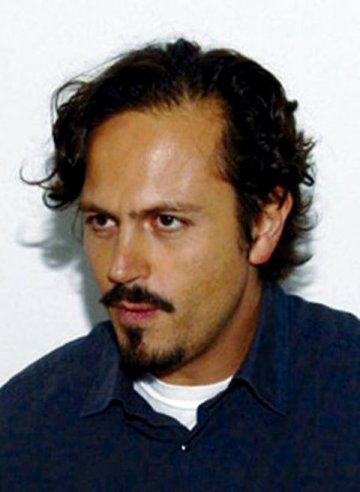
This interview was made over an exchange of emails during May and June 2008 between Anna Hiddleston and Sinziana Ravini in Paris and the artist resident in Berlin. The questions were originally written in English and the answers in Spanish and translated into English by Carmen Cebreros in Mexico City.
AH & SR.: Can you start by describing your working methods, your use of drawings or small-scale models for example? What is the origin of your ideas?
DO.: My faculty for abstraction is not very good. I need to draw, see and make things in order to understand them. The prototypes help me to be sharper. Ideas are like electric connections. In some ways they are accidents, like sparks. There are situations or experiences that become important for totally subjective reasons.
AH & SR.: Humour, double meanings and wordplay seem to be quintessential to your work. You began your career as a political cartoonist. What were you laughing at back then and what are you laughing at right now?
DO.: Double meaning has a very strong role in politics in Mexico. Word games generate complicity and conclusive social disqualifications. They occur in climates and tones so veiled and funny that they can pass completely unnoticed. There is an implicit but secret conspiracy in some answers that can be recognised only by the accomplice. These double meanings are very vulgar of course, very sexual and highly macho. I enjoy the most painful jokes; the ones that only happen among friends and that no one else can understand. The most painful jokes tell you something that is true and restrained which suddenly comes out.
AH & SR.: Indeed your photos often come in series of three or four. Do you feel at ease with this interpretation? And if not, what is your specific formal relationship to the world?
DO.: I suppose the world could contain as many forms of growth as there are species on earth. I am attracted by slow, articulated progression, where one thing generates another; and changes happen that are not always perceived. This spiral ascending growth – which ramifies like a plant - is linked to my conception of narrative, based on the anecdote. Narrative can be accelerated but it is always a succession of events. Acción/reacción is a large system of communication, just like each grain of sugar in the photo-sequence Conducción de energía. The succession of images as a narrative technique is a very natural consequence for me after my work producing comic strips for a newspaper. It was interesting to talk about politics not only from an analytical position. The medium has such a political impact that it can provoke reactions and public discussion with political repercussions. In a newspaper politics are not mere references, politics are produced there.

Damian Ortega/ Damian Ortega _cosmic thing
AH & SR.: In your piece Champ de vision, for the Espace 315, the visitor is invited to walk around shifting layers of transparent coloured spheres before turning to view the installation through a lens, at which point the spheres come together to form an eye. The eye is a heavily charged image in art history, literature and, of course, photography ?
DO.: One of my intentions is to stress the transitional zones between internal and external space. I look for the intermediate area or the threshold, where an object becomes an image as it crosses the eye, and then integrates the subjective mind’s space. It is both inside and outside, in the window and in the reflection of light towards the interior. These thresholds I am talking about are spaces where reality transforms gradually, until it turns into a memory, an idea or mental image.
AH & SR.: You show that the beholder is also a creator, for it is he/she who holds the key to the final image. Which is more interesting for you: what the beholder sees or the process he undergoes?
DO.: Well, it depends on the moment. While I am making the piece, I enjoy vagueness and parallel references from my own experience, and that is pretty selfish. However, when the time comes to install the piece, I mostly enjoy the other part – which is selfish too – in which the work fills a physical space and volume and people interact with it. It is very exciting. To have ideas is easy in a way; to make them happen, and let them find their own life is harder.
AH & SR.: With Spirit and Matter, 2004, you evoke the idea of distancing oneself from an experience and creating a memory of it. You explain how the work offers two viewpoints. One viewpoint is physical, as the visitor is invited to walk through the structure, and one viewpoint is conceptual, seen from the outside, where the structure comes together to form the words “spirit” and “matter”. Can this be applied to the role of the lens in your current installation?
DO.: Champ de vision is a constellation, hanging from the ceiling of the Espace 315, which people can walk around. It is a kind of semi-transparent, penetrable shape, formed by primary-coloured spheres dispersed in the space. My intention is that when the visitor enters the exhibition room, he/she can feel the complete space and be immediately immersed in it. I want him/her to become an integral part of the piece from the inside. At the same time, there is a darkened area at one end of the room for the spectator to establish a different kind of relationship with the piece, to see it from another point of view. From here, the perspective is more synthetic, condensed, immaterial and illusory.
AH & SR.: For the Espace 315, the way you let the beholder reconstruct the dispersed image of the eye gives him or her the privileged position of creating order from disorder. Do you have any interest in chaos theory or are you more interested in the humanist tradition of central?
DO.: When I did the expanded vision of the Volkswagen in Cosmic Thing, 2002, I was surprised by the emptiness generated at its centre. The absence of the driver, for example, is palpable in the front seat. Controller of the Universe is also part of an “explosion”. The centre of this piece is the beholder’s viewpoint towards which all the suspended tools converge. The same thing happens in the piece for Espace 315 at the Centre Pompidou. It is also a work that recalls the humanist point of view. It is about a glance that can never grasp the absolute perspective of things. It is partial and eclipsed: a visual trap.

- Alexis Peskine, Twenty things you should know about Alexis Peskine...
- Philippe Bordas, Afrique Héroïque
- Esther Shalev-Gerz, Regarding Your Image Regarding Me
- Laurent Grasso, THE HORN PERSPECTIVE
- Valérie Belin, Creative obsession of the image
- Manuel Vason, The man beyond The Encouters
- Gérard Uféras, States of Grace
- Michel Comte, Empathic & Emblematic
- Frida Kahlo, Mexican Estridentism and Realism
- Thomas Nozkowski, The Revolutionary painting
- Wangechi MUTU, Anthropological Art - Beauty + Horror
- Mario García Torres, Red + Black + Sound...
- Louise Bourgeois 1911 - 2010, Sculptor of timeless sculpture
- Barkley L. Hendricks, Birth of the cool
- Howard Schatz, Liquid Light Series
- Josef Hoflehner, Mystery and Sensuality of Black & White
- Abraham-Louis Breguet, An Apogee of European Watchmaking
- MILES in MTL..., We Want Milles: Jazz Face to Face with its legend
- Nick Brandt, Living on Earth...
- Christian Coigny, IN PROJECT
- Brendan Lee Satish Tang, Remix Generation
- Ara Güler, Lost Istanbul: 1950s and 60s
- Helmut Newton, SUMO, the biggest, most lavish book production of the 20th century is back!
- Oleg Dou (Duryagin), Subliminal photographs
- Jean-Michel Basquiat, SAMO the shooting star.
- Robert Rauschenberg, Gluts
- Le Mouvement, From Cinema to Kinetics
- FRIDA KAHLO, Y SU MUNDO
- Gerhard STEIDL, Fine art of Steidl book + Last Impressions
- UUTURAUTIIT, Cape Dorset celebrates 50 years of printmaking
- Daphne Odjig, Pow Wow at Wikwemikong
- Anish Kapoor, The Metaphysical thinker
- THE NUDE, In Modern Canadian Art, 1920-1950
- Sirine Fattouh, Lost - Won + The Remake
- Gabor Szilasi, The Eloquence of the Everyday
- Pierre Soulages, Painter of black and light
- Languages of Futurism, The artistic expressions of Futurism
- Frank Lloyd Wright, From Within Outward
- Denise Colomb, And the West Indies (1948-1958)
- BEYOND KIOSK, Modes of multiplication
- Ferdinando Scianna, Geometry + Passion
- Vanity Fair Portraits, Photographs 1913-2008
- Cai Guo-Qiang, I Want to Believe
- Nikolay Polissky, Large Hadron Collider
- Graffiti, Born in the streets
- Picasso Cézanne, Picasso looks at Cézanne
- Milton Glaser, The Modernist
- Philippe Parreno, VOICE-OVER
- NOMADS, Nomadism in Vancouver
- CARLO VALSECCHI, Lumen
- NAVIN RAWANCHAIKUL, SUPER CHINA!
- The Space of Words, Heterogeneous relationships between words and space
- The Jazz Century, I Love Jazz!
- MONA HATOUM, Measures of entanglement
- THE TAG, An Gallizia collection at The Grand Palais
- Andy Warhol, WARHOL TV
- FIFA 2009, The splendour continues!
- Sophie Ristelhueber, Temporal + spatial + Images
- Shilpa Gupta & Mahzarin Banaji, While I Sleep
- This Side of Paradise, Los Angeles (1865-2008)
- Ray Caesar & Kosta Kulundzic, The Outsiders
- William Eggleston, An American in Paris…
- Beatriz Milhazes, Natural forms + rigorous geometry
- Norbert Wagenbrett, Die Neue Sachlichkeit
- Erich Salomon, The King of the Indiscreet, 1928-1938
- DAMIÁN ORTEGA, CHAMP DE VISION
- Arthur Elgort, Le Dandy de la photographie
- Göksin Sipahioglu, Sir Sipa, photographer
- Ezra Stoller, An quiet Architect-Photographer
- Valérie Belin, La peau des choses
- Raymond Depardon + Paul Virilio, Native Land - Stop Eject
- Roman Cieslewicz, A man with a strong vision of creativity
- LE FUTURISME À PARIS, UNE AVANT-GARDE EXPLOSIVE
- OCEANIA, Signs of ritual, symbols of authority
- Picasso and the Masters, Pictural dialogue
- Brian Finke, Flight Attendants
- Balthasar Klossowski, Balthus - 100th anniversary
- 4 Days in Mongolia, Glimpses of life...
- Warwick Saint, Un garçon qui aimait les filles...
- Jacek Jarnuszkiewicz, Man is a thinking reed No3
- The Dashanzi revolution, Displays contemporary art in the Bauhaus style
- Gyula Halász, Brassaï in the night
- Jules Kulein, Desire + Graphism + Provocation
- Steven Meisel, Makeover Lightness
- RON MUECK + GUY BEN-NER, REAL LIFE
- Herb Ritts, A self-taught photographer
- H BOX, H as Hermès
- Juan Muñoz, A narrator sculptor
- Thomas Scheibitz, About 90 elements/TOD IM DSCHUNGEL
- Richard Long, A Walking Sculptor
- Geoffrey James, Utopia/Dystopia contrasts ideal society with a world gone awry
- Club of 8, The 2008 Governor General’s Awards in Visual and Media Arts
- Robert Mapplethorpe, Lisa + Milton + Thomas & Ken
- China Power Station, PART III
- César Baldaccini, An Anthology by Jean Nouvel
- Seydou Keita, 50 Works
- Floriane de Lassée, Inside Views
- Monsengwo Kejwamfi Moke, Father of the Popular painting movement in Congo
- Alexander Rodchenko, Revolution in photography
- Special future: Controversies, A legal and ethical history of photography
- Richard Avedon, Photographs 1946 - 2004”
- Alec Soth, L'espace entre nous
- The 1930s at The MBAC, The Making of
- Patti Smith, Land 250
- Keith Haring, A Summer with Jean-Michel Basquiat
- Andrea Branzi, Open Enclosures
- Glenn Ligon, I Am A Man
- ¡CUBA!, A voyage through this Island’s Art and History, from 1868 to today
- Michael Craig-Martin, Father of Brit-Art
- Lee Bul, On Every New Shadow
- 20 Creative People for 2008, Who are changing your world - 2008
- Richard Serra, Master of the tectonic nature of sculpture
- Eija-Liisa Ahtila, The House Sculptures
- Gerda Taro, A revolutionary photographer in the Spain’s war
- Ray Caesar, A Toronto, les chats sont gris la nuit…
- De Superman au Chat du Rabbin, From the Shtetl to the devouring metropolis
- Takashi Murakami, The mass-market machine man
- Albert Watson, A provocative testimony
- Yayoi Kusama, Scandalously artist!
- Daphne Odjig, "Picasso's grandmother" + The Indian transition
- Yin Xin, The western most Chinese painters
- Carlito Dalceggio, Anatomy of the invisible
- Graffiti is art or bullshit ?, A brief history of graffiti movement
- TaTa Sam Bejan, A Tribute to an humanist photographer
- Edward Steichen, Master of Photography
- Pierre and Gilles, Double Je (1976 - 2007)
- Five Nights at the Museum, The union of Art with Architecture
- Frida Kahlo, Centenary of the great concealer within enigmatic eyebrows
- What the World Eats ?, Have a dinner !
- Le Tour du monde de la Pub, Broken course of the history of advertising
- The Situationist International (1957–1972), An Bauhaus imaginiste
- Kurt Wyss, Photographic Encounters
- Zhu Yunwei, Opened / closed eyes, awoken dream of a photographer
- David Lynch, The Air is on Fire
- FIFA : A quarter-century of pure splendour!, 25th International festival of films on art
- Twenty things you should know about Eva Van Den Bulcke..., Schlof project
- Shomei Tomatsu, Skin of the Nation
- Centre Pompidou, 30 years of world culture!
- 35 New Photographers 2007, Photographers of tomorrow, selected by Getty Images Bank
- Valérie Belin, The anthropometric method: Metamorphosis or transformation?
- The Event,, Images as protagonists of history
- Nacho Lopez, Revelations and Miracles
- A History of Advertising: Photography in France, from Man Ray to Jean-Paul Goude
- Desiree Dolron: Exaltation - Gaze - Xteriors, The mystic photography
- Paris celebrates international photography, Paris Photo celebrates its tenth anniversary with a sparkling selection of Nordic talent
- Lee Friedlander, -
- NRC Scientists Help Solve the Mysteries behind the Mona Lisa, -
- Digimart - Take 1, Global Digital Distribution Summit
- Joel Meyerowitz, Out of the Ordinary, 1970-1980
- J. Shulman, Modernity and the Metropolis, July 2006 / NBM, Washington D.C
- Nicolas Ruel, Inox
- Egodesign.ca has arrived!, www.egodesign.ca’s June 22, 2006 online debut was a resounding success.
- Art Home